
Secure your financial future with a comprehensive understanding of retirement savings calculators. These invaluable tools empower individuals to project their retirement income, factoring in crucial variables like current savings, contributions, and investment returns. By exploring different calculator types and understanding their underlying mechanisms, you can gain valuable insights into your personal retirement planning needs.
This guide delves into the intricacies of retirement calculations, examining the impact of inflation, investment risk, and diverse retirement account options. We’ll explore various investment strategies, offer best practices for using calculators effectively, and provide illustrative examples to clarify the long-term implications of your savings choices. Ultimately, this guide aims to equip you with the knowledge to make informed decisions and achieve your desired retirement lifestyle.
Understanding Retirement Savings Calculators
Retirement planning can feel daunting, but thankfully, several tools are available to help you visualize your financial future. Retirement savings calculators are among the most useful, offering a range of features to project your potential retirement nest egg. Understanding their functionality and limitations is crucial for effective financial planning.Retirement savings calculators are essentially financial modeling tools that estimate your future retirement income based on various inputs.
They provide a snapshot of your potential financial situation at retirement, helping you determine if your current savings and contribution strategy is sufficient to meet your goals. Different calculators offer varying levels of complexity and sophistication, catering to different needs and levels of financial literacy.
Types of Retirement Savings Calculators
Retirement savings calculators come in various forms, each with its own strengths and weaknesses. Simple calculators provide a basic projection, while more advanced calculators incorporate factors like inflation, taxes, and variable investment returns. For example, a simple calculator might only require your current savings, annual contributions, and assumed rate of return to estimate your final retirement balance. More advanced versions might allow for adjustments to contributions over time, account for different investment asset allocations (stocks, bonds, etc.), and factor in the effects of inflation on both your savings and expenses.
Some even incorporate tax implications, providing a more realistic picture of your post-tax retirement income.
Key Inputs for Retirement Calculators
Most retirement calculators require similar core inputs to generate a projection. These inputs typically include:
- Current Age: Your current age is essential for determining the time horizon for your savings to grow.
- Desired Retirement Age: This determines the number of years you have to save and the length of your retirement.
- Current Savings: The current amount of money you have saved for retirement in all accounts.
- Expected Annual Contributions: The amount you plan to contribute annually to your retirement savings.
- Estimated Rate of Return: The average annual return you expect your investments to generate. This is often based on historical market performance but should be considered an estimate.
While these are core inputs, more sophisticated calculators may also request information regarding investment allocation, inflation expectations, and planned retirement withdrawals.
Comparison of Retirement Calculators
The following table compares three hypothetical retirement calculators, highlighting their features and limitations:
| Feature | Calculator A (Simple) | Calculator B (Intermediate) | Calculator C (Advanced) |
|---|---|---|---|
| Inflation Adjustment | No | Yes | Yes (adjustable inflation rate) |
| Tax Considerations | No | No | Yes (multiple tax bracket options) |
| Variable Contribution Rates | No (fixed contribution) | Yes (allows for changes over time) | Yes (allows for complex contribution schedules) |
| Investment Allocation | Single asset class | Multiple asset classes (pre-defined) | Multiple asset classes (customizable allocation) |
| Withdrawal Strategy | Fixed percentage withdrawal | Fixed dollar amount withdrawal | Variable withdrawal strategy (adjustable based on market performance) |
| Limitations | Overly simplistic; ignores inflation and taxes | Does not account for taxes; limited customization | Requires more complex inputs; assumptions may not be perfectly accurate |
Factors Influencing Retirement Savings Calculations
Accurately projecting your retirement needs requires considering several key factors that significantly impact the final calculations. These factors interact in complex ways, and understanding their influence is crucial for developing a realistic and effective retirement savings plan. Ignoring even one of these elements can lead to a substantial shortfall or, conversely, unnecessary over-saving.
Inflation’s Impact on Retirement Projections
Inflation erodes the purchasing power of money over time. A dollar today will not buy the same amount of goods and services in the future. Retirement savings calculators must account for inflation to accurately reflect the future value of your savings. For example, if you project needing $50,000 annually in retirement in 20 years, and inflation averages 3% annually, you’ll actually need significantly more than $50,000 in real terms to maintain that same purchasing power.
Calculators typically use an assumed inflation rate to adjust future expenses, ensuring your savings projections reflect the true cost of living in retirement. Failing to account for inflation leads to an underestimation of the funds needed for a comfortable retirement.
Investment Risk and Return in Retirement Planning
The rate of return on your investments is a pivotal factor in determining the growth of your retirement savings. Higher-risk investments, such as stocks, offer the potential for higher returns but also carry the risk of losses. Conversely, lower-risk investments like bonds generally offer lower, but more stable, returns. Retirement calculators often allow you to specify your risk tolerance and investment strategy, using this information to model different potential growth scenarios.
For instance, a conservative strategy might assume a lower average annual return, resulting in a higher savings target compared to an aggressive strategy. The chosen investment strategy directly affects the projected retirement income.
Retirement Account Types and Their Influence on Calculations
Different retirement accounts offer various tax advantages and contribution limits that influence calculations. A 401(k) is a tax-deferred account offered through employers, allowing pre-tax contributions to reduce current taxable income. Traditional IRAs also offer tax-deferred growth, while Roth IRAs provide tax-free withdrawals in retirement. Retirement calculators need to distinguish between these account types to accurately reflect the tax implications of withdrawals and the impact of contributions on current income.
For example, a Roth IRA’s tax-free withdrawals result in a higher effective retirement income compared to a traditional IRA with taxable withdrawals.
Impact of Different Investment Strategies on Projected Retirement Income
Investment strategies, ranging from conservative to aggressive, dramatically affect projected retirement income. A conservative strategy, typically involving a larger allocation to bonds and less to stocks, offers lower risk but also lower potential returns. An aggressive strategy, conversely, prioritizes higher growth potential through a larger stock allocation but comes with increased risk of losses. Retirement calculators simulate various scenarios based on the chosen strategy, illustrating the trade-off between risk and return.
For instance, a conservative strategy might project a lower but more reliable retirement income, while an aggressive strategy could project higher income but with greater uncertainty.
Using a Retirement Savings Calculator Effectively
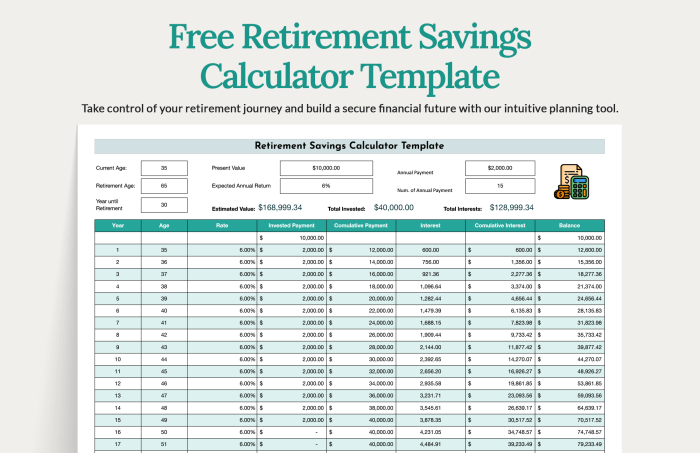
Retirement savings calculators are powerful tools, but their effectiveness hinges on accurate input and a clear understanding of the output. Using them correctly can significantly improve your retirement planning by providing a realistic projection of your future financial situation. This section details best practices for maximizing the value of these calculators.
Accurate Data Input
Accurate input is paramount for reliable results. Begin by honestly assessing your current financial situation. This includes your current savings, annual contributions, and expected investment returns. Be realistic about your expenses; overestimating your income or underestimating your expenses will lead to inaccurate projections. Consider using average annual returns based on historical data for different asset classes rather than relying on overly optimistic predictions.
For example, instead of using a high projected return rate based on recent market gains, refer to the average annual return of a specific index fund over a longer period (e.g., 10-20 years) to obtain a more realistic expectation. Pay close attention to the calculator’s instructions regarding the input format for dates, percentages, and currency. Double-checking your entries before running the calculation is a crucial step to ensure accuracy.
Interpreting Calculator Results
Once the calculation is complete, the calculator will typically provide a projected retirement income or savings balance at a specific date. Carefully review the summary of your projected savings and income at retirement, noting the assumed growth rate and the impact of inflation on your savings. Pay attention to any sensitivity analysis offered by the calculator; this will show how changes in key variables impact the final projection.
Understand the assumptions made by the calculator, such as the investment growth rate and inflation rate. Remember that these are estimates, and the actual outcome may vary. The results should be viewed as a guide, not a guarantee, of your future financial situation. Consider running multiple scenarios with varying inputs to understand the range of possible outcomes.
Adjusting Inputs for Desired Income
Retirement calculators allow you to experiment with different inputs to achieve your desired retirement income level. If the projected income is lower than your target, you can adjust several variables. Increasing your annual contribution is the most direct way to increase your projected retirement income. Alternatively, you could consider extending your working years, which would allow for a longer period of savings accumulation.
Another option is to explore higher-return investment strategies, though this involves accepting a higher level of risk. The calculator can help you understand the trade-offs between these options. For instance, you can input different retirement ages to see how much longer you would need to work to reach your goal, or see how much more you’d need to save each year to retire earlier.
Hypothetical Scenario: Impact of Variable Changes
Let’s assume Sarah aims to retire with $1 million at age 65. She’s currently 35, contributes $5,000 annually, and expects an average annual return of 7%.
- Scenario 1 (Baseline): With a $5,000 annual contribution and a 7% return, the calculator projects approximately $1,000,000 at age 65.
- Scenario 2 (Increased Contributions): Increasing annual contributions to $10,000, while keeping the return rate at 7%, significantly boosts her projected savings, potentially exceeding $1.5 million by age 65.
- Scenario 3 (Lower Return Rate): Maintaining the $5,000 annual contribution but reducing the expected return to 5% results in a lower projected amount at age 65, potentially around $700,000. This highlights the importance of realistic return expectations.
- Scenario 4 (Delayed Retirement): If Sarah delays retirement to age 70, keeping the initial $5,000 contribution and 7% return, her projected savings would likely exceed $2 million due to the extended investment period. This demonstrates the power of compounding over time.
These scenarios illustrate how even small changes in contribution amounts, investment returns, and retirement age can significantly impact the final retirement projection. Remember that these are simplified examples, and real-world situations involve more complexities.
Retirement Planning and Savings Strategies
Planning for retirement requires a proactive and strategic approach. The earlier you begin saving, the more time your investments have to grow, leveraging the power of compound interest to build a substantial nest egg. Understanding various savings strategies and utilizing employer-sponsored plans can significantly enhance your retirement security.
The Importance of Starting Early
The benefits of starting retirement savings early are substantial. Compound interest, the interest earned on both the principal amount and accumulated interest, is a powerful tool for wealth building. Imagine investing $1,000 annually starting at age 25 versus starting at age 35. Assuming a 7% annual return, the difference at age 65 would be remarkably significant, potentially hundreds of thousands of dollars.
This illustrates the exponential growth potential that early investment provides. Delaying even a few years can dramatically impact the final retirement corpus.
Strategies for Maximizing Retirement Savings Contributions
Maximizing retirement savings requires a multi-pronged approach. Several strategies can be employed to increase contributions and accelerate wealth accumulation.
- Automate Contributions: Setting up automatic transfers from your checking account to your retirement account ensures consistent contributions, even if you don’t actively think about it each month.
- Increase Contribution Percentage Regularly: Schedule regular increases to your contribution percentage, perhaps annually or whenever you receive a raise. This ensures your savings grow with your income.
- Contribute to Employer Matching: If your employer offers a matching contribution program, contribute at least enough to receive the full match. This is essentially free money, and you shouldn’t miss out on it.
- Consider a Roth IRA: A Roth IRA offers tax-free withdrawals in retirement, which can be beneficial in the long run, even if contributions are not tax-deductible.
- Diversify Investments: Diversifying investments across different asset classes (stocks, bonds, real estate, etc.) helps mitigate risk and potentially enhance returns.
Benefits of Employer-Sponsored Retirement Plans
Employer-sponsored retirement plans, such as 401(k)s and 403(b)s, offer significant advantages.
- Employer Matching: Many employers offer matching contributions, effectively increasing your savings. This is a substantial benefit that should not be overlooked.
- Tax Advantages: Contributions to many employer-sponsored plans are often tax-deductible, reducing your current taxable income.
- Convenience: Contributions are typically deducted directly from your paycheck, making saving automatic and hassle-free.
- Investment Options: These plans usually offer a variety of investment options to suit different risk tolerances and financial goals.
Methods for Increasing Retirement Savings
Increasing retirement savings can involve either boosting income or cutting expenses.
- Reducing Expenses: Identify areas where you can cut back on spending, such as dining out less, reducing entertainment costs, or negotiating lower bills. Even small reductions can accumulate over time.
- Increasing Income: Explore ways to boost your income, such as taking on a side hustle, asking for a raise, or seeking a higher-paying job. Increased income directly translates to more savings potential.
Planning for retirement is a journey, not a destination, and a retirement savings calculator serves as your essential compass. By understanding the nuances of these tools and thoughtfully considering the factors influencing your projections, you can create a personalized retirement plan that aligns with your aspirations. Remember, consistent contributions, strategic investment choices, and early planning are key to securing a comfortable and financially secure retirement.
Take control of your future; start planning today.
Question & Answer Hub
How often should I update my retirement savings projections?
It’s recommended to review and update your projections at least annually, or more frequently if there are significant life changes (e.g., job change, major purchase).
What if I don’t have any current savings? Can I still use a calculator?
Yes, absolutely. Retirement calculators can help you visualize the impact of starting to save now, even with a zero balance. It highlights the power of compounding over time.
Are there calculators that account for potential healthcare costs in retirement?
Some advanced calculators incorporate estimates for healthcare expenses, but these are often based on averages and may not be perfectly accurate. It’s best to factor in a conservative estimate based on your individual circumstances.
What is the difference between a simple and an advanced retirement calculator?
Simple calculators provide basic projections based on limited inputs. Advanced calculators offer more sophisticated models, accounting for factors like inflation, varying contribution rates, and different investment strategies.


