
Securing a comfortable retirement requires careful planning and a proactive approach to saving. The question, “How much should I save for retirement?”, is paramount, and the answer depends on a complex interplay of factors. This guide explores the key elements of retirement planning, from defining your desired lifestyle to developing a robust investment strategy, empowering you to make informed decisions about your financial future.
Understanding your current financial situation, projecting future expenses, and selecting appropriate investment vehicles are crucial steps. We’ll delve into various methods for calculating your savings needs, considering factors like inflation, investment returns, and your chosen retirement age. The goal is to equip you with the knowledge and tools to build a financially secure retirement.
Defining Retirement Goals and Needs
Planning for retirement involves much more than simply saving a certain amount of money. A successful retirement hinges on carefully considering your desired lifestyle and the financial resources needed to support it. Understanding your personal goals and needs is the crucial first step in creating a robust retirement plan.Retirement lifestyles vary considerably, each with its own cost implications.
A comfortable retirement isn’t a single, universally defined concept; it’s highly personalized.
Retirement Lifestyle Costs
Different retirement lifestyles demand varying levels of financial resources. For example, a retiree who enjoys extensive travel, fine dining, and frequent entertainment will require significantly more funds than someone who prefers a simpler life focused on home-based hobbies and modest social activities. Consider these examples:
- Luxury Retirement: This lifestyle might involve extensive international travel, a large home in a desirable location, private healthcare, and a generous entertainment budget. Annual costs could easily exceed $150,000, depending on location and preferences.
- Comfortable Retirement: This entails a more moderate lifestyle, perhaps with occasional travel, a smaller home in a less expensive area, and a focus on maintaining social connections and engaging in hobbies. Annual costs could range from $50,000 to $100,000, varying significantly based on location and choices.
- Modest Retirement: This lifestyle emphasizes frugality and focuses on essential needs and limited discretionary spending. Annual costs could be as low as $30,000, but this requires careful budgeting and might involve downsizing and limiting non-essential expenses.
Factors Influencing Individual Retirement Needs
Several factors significantly influence individual retirement needs, making it crucial to personalize your retirement plan. These factors go beyond simple living expenses.
- Healthcare Costs: Healthcare expenses can be substantial, especially in later years. The cost of insurance premiums, medications, and potential long-term care significantly impact retirement budgets. For instance, the average annual cost of a nursing home stay in the United States can exceed $100,000.
- Geographic Location: The cost of living varies dramatically across different regions. Retiring in a high-cost area like New York City will require significantly more savings than retiring in a lower-cost area like rural Iowa. Housing costs alone can account for a substantial portion of retirement expenses.
- Hobbies and Interests: Your hobbies and interests will significantly influence your retirement spending. Active hobbies like golf or travel require more funding than passive hobbies like reading or gardening. Consider the ongoing costs associated with your preferred activities.
- Unexpected Expenses: It’s crucial to factor in unexpected expenses, such as home repairs, medical emergencies, or assisting family members. Having a financial cushion for unforeseen circumstances is essential for a secure retirement.
Framework for Setting Realistic Retirement Goals
Establishing realistic and achievable retirement goals involves a structured approach. This involves assessing your current financial situation, projecting future expenses, and determining the necessary savings to bridge the gap.
- Assess Current Finances: Begin by meticulously evaluating your current assets, including savings, investments, and retirement accounts. Understand your current income and expenses to establish a baseline.
- Project Future Expenses: Based on your desired retirement lifestyle and the factors discussed above, estimate your annual expenses in retirement. Consider inflation and potential changes in healthcare costs.
- Determine Savings Gap: Compare your projected retirement expenses with your anticipated retirement income (e.g., Social Security, pensions). The difference represents the savings gap you need to address.
- Develop a Savings Plan: Create a detailed savings plan that Artikels how you’ll bridge the savings gap. This might involve increasing contributions to retirement accounts, adjusting your spending habits, or exploring additional investment strategies.
- Regularly Review and Adjust: Retirement planning is an ongoing process. Regularly review your plan to ensure it remains aligned with your goals and adjust it as needed to account for changes in circumstances or market conditions.
Assessing Current Financial Situation
Understanding your current financial standing is crucial for effective retirement planning. A clear picture of your assets, liabilities, income, and expenses provides a solid foundation for setting realistic savings goals and developing a sound financial strategy. This involves creating a personal balance sheet and tracking your cash flow.
Personal Balance Sheet Creation
A personal balance sheet is a snapshot of your financial health at a specific point in time. It lists your assets (what you own) and liabilities (what you owe), allowing you to calculate your net worth. Creating one involves systematically identifying and documenting all your financial holdings and debts.
To begin, list all your assets. This includes liquid assets like checking and savings accounts, money market funds, and readily available cash. Then, list your illiquid assets such as your home, vehicles, investments (stocks, bonds, mutual funds, retirement accounts), and any valuable possessions. For each asset, record its current market value or estimated value, if applicable. Next, list all your liabilities, including outstanding balances on credit cards, loans (auto, student, personal), mortgages, and any other debts.
Record the current balance for each liability.
Net Worth Calculation and Relevance
Net worth is calculated by subtracting your total liabilities from your total assets. The formula is:
Net Worth = Total Assets – Total Liabilities
For example, if your total assets are $250,000 and your total liabilities are $100,000, your net worth is $150,000. Your net worth is a key indicator of your financial health and plays a vital role in retirement planning. A higher net worth provides a larger financial cushion and greater flexibility in retirement. Tracking your net worth over time allows you to monitor your progress toward your retirement goals and make necessary adjustments to your financial plan.
Income and Expense Tracking Strategies
Understanding your income and spending habits is essential for creating a realistic budget and saving effectively for retirement. There are several methods for tracking your income and expenses. You can use a simple spreadsheet, a budgeting app, or even a notebook to record your income and expenses.
For income, list all sources, including salary, wages, investments, and any other income streams. For expenses, categorize them (housing, transportation, food, entertainment, etc.) for a clearer picture of your spending patterns. Regularly reviewing your tracked data helps identify areas where you can potentially reduce spending and allocate more funds towards retirement savings. This might involve cutting back on non-essential expenses or finding ways to increase your income.
Estimating Retirement Expenses
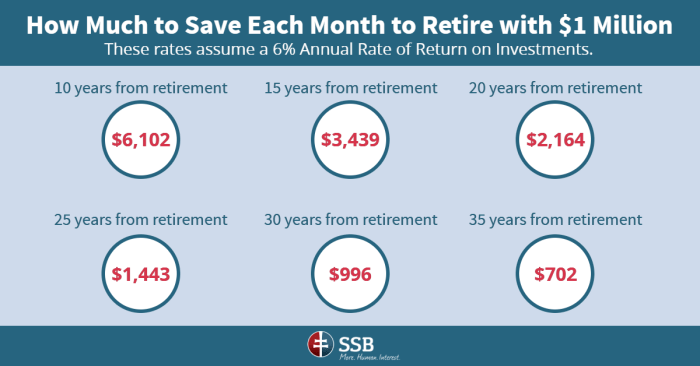
Accurately estimating your retirement expenses is crucial for ensuring a comfortable and financially secure retirement. Failing to account for all potential costs can lead to significant financial hardship later in life. This section will break down common retirement expenses, discuss the impact of inflation, and provide examples to help you create your own personalized retirement budget.
Common Retirement Expenses
Retirement expenses vary significantly depending on lifestyle, location, and health. However, several categories consistently represent a substantial portion of overall costs. These include housing (rent or mortgage payments, property taxes, maintenance), healthcare (medical insurance premiums, prescription drugs, long-term care), food, transportation, utilities, entertainment, and travel. Unexpected expenses, such as home repairs or medical emergencies, should also be factored into your planning.
Inflation’s Impact on Retirement Expenses
Inflation steadily erodes the purchasing power of money over time. A dollar today will not buy the same amount of goods and services in the future. To accurately estimate future retirement expenses, it’s essential to account for inflation. A common method is to use an inflation rate projection—typically between 2% and 3% annually—to adjust your current expenses for future years.
For instance, if your current annual healthcare expense is $5,000, and you project a 3% annual inflation rate for 20 years, your estimated annual healthcare cost in retirement would be significantly higher. You can use online inflation calculators to assist with these projections. Failing to account for inflation can severely underestimate your retirement needs, leading to insufficient savings.
Sample Retirement Budgets
Let’s consider three hypothetical scenarios illustrating how retirement expenses vary with income levels:Scenario 1: A retired couple with a modest income of $40,000 per year might allocate their budget as follows: Housing ($15,000), Healthcare ($10,000), Food ($8,000), Transportation ($3,000), Utilities ($2,000), Entertainment ($1,000), and Miscellaneous ($1,000). This scenario assumes a relatively frugal lifestyle.Scenario 2: A retired couple with a comfortable income of $80,000 per year might allocate their budget as follows: Housing ($25,000), Healthcare ($15,000), Food ($12,000), Transportation ($5,000), Utilities ($4,000), Entertainment ($4,000), Travel ($5,000), and Miscellaneous ($5,000).
This scenario reflects a more generous lifestyle with increased spending on travel and entertainment.Scenario 3: A retired couple with a high income of $150,000 per year might have a budget significantly exceeding the previous examples, with potentially higher costs in all categories, particularly housing, healthcare, and travel, alongside significant amounts allocated for philanthropy or other personal pursuits.
Retirement Expense Comparison Across Lifestyles
| Lifestyle | Housing | Healthcare | Transportation | Other Expenses |
|---|---|---|---|---|
| Frugal | $15,000 | $10,000 | $3,000 | $12,000 |
| Comfortable | $25,000 | $15,000 | $5,000 | $35,000 |
| Luxury | $50,000 | $25,000 | $10,000 | $65,000 |
| Average (National Estimate)* | $20,000 | $12,000 | $4,000 | $24,000 |
Note
Average figures are estimates and will vary based on location and individual circumstances. These figures are for illustrative purposes only.
Investment Strategies for Retirement Savings
Planning your retirement investments requires careful consideration of various factors, including your risk tolerance, time horizon, and financial goals. A well-diversified portfolio, strategically allocated across different asset classes, is crucial for maximizing returns while mitigating potential losses. This section will explore various investment options and strategies to help you build a robust retirement plan.
Comparing Investment Options Based on Risk Tolerance
Different investment options carry varying levels of risk and potential returns. Stocks, for instance, offer higher growth potential but also come with greater volatility compared to bonds, which are generally considered less risky. Real estate presents a unique investment opportunity, offering potential appreciation and rental income, but also involves higher upfront costs and potential illiquidity. Your risk tolerance – your comfort level with the possibility of losing some of your investment – should significantly influence your asset allocation.
A younger investor with a longer time horizon might tolerate higher risk in pursuit of greater returns, while an older investor nearing retirement might prioritize capital preservation and opt for a more conservative approach. For example, a younger investor might allocate a larger portion of their portfolio to stocks, while an older investor might favor bonds and lower-risk investments.
Retirement Investment Vehicles: Benefits and Drawbacks
Several investment vehicles offer tax advantages and other benefits for retirement savings.
- 401(k) Plans: Employer-sponsored retirement plans that often include matching contributions. The main benefit is the tax-deferred growth, meaning you don’t pay taxes on your earnings until retirement. However, contributions are limited by annual contribution limits set by the government, and access to funds before retirement may be restricted and penalized.
- Traditional IRAs: Individual Retirement Accounts that offer tax-deductible contributions. Similar to 401(k) plans, earnings grow tax-deferred. However, withdrawals in retirement are taxed as ordinary income. Contribution limits also apply.
- Roth IRAs: Contributions are made after tax, but withdrawals in retirement are tax-free. This offers a significant advantage, especially if you anticipate being in a higher tax bracket in retirement. Contribution limits apply, and income limits restrict eligibility.
The choice between these vehicles depends on individual circumstances, such as current and projected tax brackets and the employer’s matching contributions for 401(k) plans. For example, a high-income earner might prefer a Roth IRA to avoid higher taxes in retirement, while someone in a lower tax bracket might benefit more from a traditional IRA’s tax deduction.
Steps for Creating a Diversified Retirement Investment Portfolio
Building a diversified portfolio involves spreading your investments across different asset classes to reduce overall risk. A well-diversified portfolio is not guaranteed to eliminate losses, but it can significantly lessen the impact of poor performance in any single asset class.
- Determine your risk tolerance and time horizon. This will guide your asset allocation strategy.
- Define your retirement goals. Knowing how much you need to retire will help determine the appropriate investment strategy and timeline.
- Choose a mix of asset classes. This typically involves stocks (for growth), bonds (for stability), and potentially real estate or other alternative investments. The specific allocation will depend on your risk tolerance and time horizon.
- Select appropriate investment vehicles. Consider 401(k) plans, IRAs, and other tax-advantaged accounts.
- Regularly rebalance your portfolio. As market conditions change, rebalance your portfolio to maintain your desired asset allocation. For example, if stocks outperform bonds, you might sell some stocks and buy more bonds to return to your target allocation.
- Monitor your investments and adjust your strategy as needed. Market conditions and personal circumstances can change, requiring adjustments to your investment plan. It is prudent to periodically review your portfolio and make necessary adjustments.
For example, a moderately risk-tolerant investor with a 20-year time horizon might allocate 60% of their portfolio to stocks, 30% to bonds, and 10% to real estate. This allocation allows for growth potential while providing some protection against market downturns. However, this is just an example and a personalized allocation should be determined based on individual circumstances and financial advice.
Planning for retirement is a journey, not a destination. While the specific amount you need to save is highly individual, the process of setting realistic goals, assessing your current financial standing, and strategically investing your savings is universally applicable. By diligently following a well-defined plan and regularly reviewing your progress, you can significantly increase your chances of achieving a fulfilling and financially secure retirement.
Remember to seek professional advice when needed to navigate the complexities of long-term financial planning.
Key Questions Answered
What if I change jobs frequently? How does that affect my retirement savings?
Frequent job changes can disrupt consistent contributions to retirement accounts. Prioritize maintaining consistent savings, even if the vehicle changes. Consider consolidating retirement accounts to simplify management.
How can I account for unexpected medical expenses in my retirement plan?
Build a financial buffer for unexpected expenses. Consider long-term care insurance or a dedicated health savings account (HSA) to mitigate potential high medical costs in retirement.
What’s the difference between a 401(k) and a Roth IRA?
A 401(k) is employer-sponsored, often with matching contributions, and taxes are deferred until retirement. A Roth IRA is funded with after-tax dollars, but withdrawals in retirement are tax-free.
When should I start drawing Social Security benefits?
The optimal age to begin receiving Social Security benefits depends on your individual circumstances and life expectancy. Consult the Social Security Administration website or a financial advisor for personalized guidance.


