
Planning for retirement can feel daunting, but understanding your options is the first step towards a financially secure future. This guide explores various retirement savings vehicles, investment strategies, and withdrawal plans, empowering you to make informed decisions aligned with your individual circumstances and goals. We’ll delve into the intricacies of different accounts, risk management, and the importance of consistent contributions to maximize your retirement nest egg.
From traditional 401(k)s and IRAs to Roth accounts and employer-sponsored plans, we’ll compare and contrast the benefits and drawbacks of each, considering factors like tax implications, contribution limits, and withdrawal rules. We’ll also discuss how to create a diversified investment portfolio tailored to your risk tolerance and time horizon, emphasizing the significance of asset allocation and long-term growth strategies.
Ultimately, the aim is to provide you with the knowledge and tools to confidently navigate the complexities of retirement planning and build a comfortable retirement.
Defining Retirement Savings Goals
Planning for retirement requires a clear understanding of your desired lifestyle and the financial resources needed to support it. This involves setting realistic savings goals that account for various factors, including inflation and unexpected expenses. Failing to adequately plan can lead to significant financial hardship in retirement.
Different retirement lifestyles demand vastly different savings amounts. A comfortable retirement might involve leisurely travel, pursuing hobbies, and maintaining a similar living standard to your pre-retirement years. Conversely, a modest retirement might focus on essential expenses with limited discretionary spending. The level of desired comfort directly impacts the amount you need to save.
Retirement Lifestyle Scenarios and Savings Needs
Consider these examples: A couple planning a luxurious retirement with extensive travel and a large home may require several million dollars in savings. In contrast, a single individual aiming for a modest retirement focused on essential living expenses might need significantly less, perhaps a few hundred thousand dollars. The specifics depend heavily on location, individual preferences, and healthcare costs.
The Impact of Inflation on Retirement Savings Goals
Inflation erodes the purchasing power of money over time. A sum that seems substantial today may be insufficient to cover the same expenses in 20 years. Therefore, it’s crucial to account for inflation when setting retirement savings goals. Failing to do so can lead to a significant shortfall in retirement income.
For example, if you project needing $50,000 per year in retirement and inflation averages 3% annually, that same $50,000 will have significantly less purchasing power in 20 years. You would need to save substantially more to maintain the same standard of living.
Calculating a Personalized Retirement Savings Target
Determining your personalized retirement savings target involves a step-by-step process. Accurate calculations require careful consideration of several key factors.
- Estimate your annual retirement expenses: Consider housing, food, healthcare, transportation, entertainment, and any other anticipated costs. Use online retirement calculators or consult a financial advisor for assistance.
- Adjust for inflation: Use an inflation rate (e.g., 3%) to project future expenses. This will provide a more realistic estimate of your needs in retirement.
- Determine your retirement duration: Estimate the number of years you’ll be in retirement. This will vary depending on your age, health, and life expectancy.
- Calculate your total retirement savings needed: Multiply your annual adjusted expenses by the number of retirement years. This gives you the total amount you need to save.
- Factor in other income sources: Consider any potential income sources in retirement, such as Social Security benefits or a pension, and subtract this from your total savings goal.
- Develop a savings plan: Create a realistic savings plan that details how you’ll achieve your retirement savings goal, including the amount you’ll save each month or year and the investment strategies you’ll use.
To illustrate, if you estimate annual expenses of $40,000 adjusted for inflation over 20 years of retirement, you’d need $800,000 ($40,000 x 20). If you anticipate $100,000 in Social Security benefits, your savings goal reduces to $700,000.
Retirement Savings Vehicles
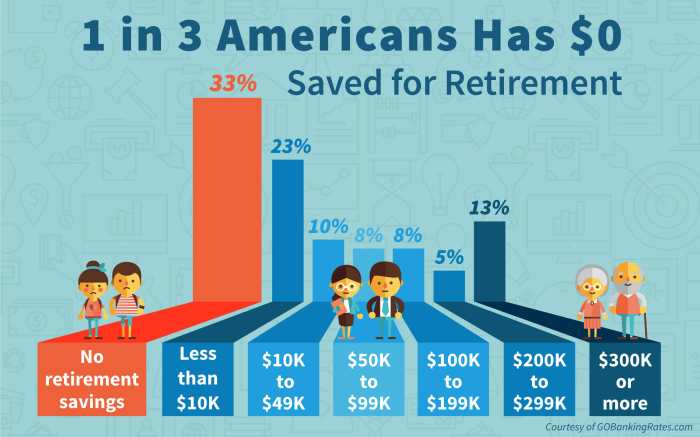
Choosing the right retirement savings vehicle is crucial for securing your financial future. Understanding the differences between various accounts and the investment options they offer will allow you to make informed decisions aligned with your personal financial goals and risk tolerance. This section will explore the key characteristics of several popular retirement savings options.
Comparison of Retirement Savings Accounts
The following table compares three common retirement savings accounts: 401(k)s, traditional IRAs, and Roth IRAs. Each account offers different benefits and drawbacks depending on your individual circumstances and tax bracket. Remember to consult a financial advisor for personalized guidance.
| Account Type | Contribution Limits (2023) | Tax Advantages | Withdrawal Rules |
|---|---|---|---|
| 401(k) | $23,000 (employee contribution), plus $7,500 (age 50+) catch-up contribution. Employer matching contributions may also apply. | Contributions are typically pre-tax, reducing your current taxable income. Investment earnings grow tax-deferred. | Withdrawals before age 59 1/2 are generally subject to a 10% tax penalty, plus income tax. Exceptions exist for certain circumstances. |
| Traditional IRA | $6,500 (individual contribution), plus $1,000 (age 50+) catch-up contribution. | Contributions may be tax-deductible, reducing your current taxable income. Investment earnings grow tax-deferred. | Withdrawals before age 59 1/2 are generally subject to a 10% tax penalty, plus income tax. Exceptions exist for certain circumstances. |
| Roth IRA | $6,500 (individual contribution), plus $1,000 (age 50+) catch-up contribution. | Contributions are made after tax, but withdrawals in retirement are generally tax-free. Investment earnings are also tax-free in retirement. | Withdrawals of contributions are always tax-free and penalty-free. Withdrawals of earnings before age 59 1/2 are generally subject to a 10% tax penalty, plus income tax. Exceptions exist for certain circumstances. |
Employer-Sponsored Retirement Plans: Benefits and Drawbacks
Employer-sponsored retirement plans, such as 401(k)s and 403(b)s, offer several advantages. Many employers offer matching contributions, essentially giving you free money towards your retirement. These plans often provide a wide range of investment options and professional investment management services. However, employer-sponsored plans may have limitations on investment choices and may be subject to vesting schedules, meaning you don’t own all of the employer’s contributions until you’ve worked for a certain period.
Portability can also be an issue if you change jobs. Understanding the specific terms of your employer’s plan is essential.
Investment Options within Retirement Savings Vehicles
Retirement savings accounts typically offer a variety of investment options, allowing you to tailor your portfolio to your risk tolerance and financial goals. Common options include stocks, bonds, mutual funds, exchange-traded funds (ETFs), and sometimes real estate investment trusts (REITs). Stocks represent ownership in a company and offer the potential for higher returns, but also carry greater risk.
Bonds are less risky but generally offer lower returns. Mutual funds and ETFs provide diversification by investing in a basket of stocks or bonds. The specific investment choices available will vary depending on the retirement plan. Careful consideration of asset allocation and diversification is crucial for long-term retirement success.
Investment Strategies for Retirement Savings
Choosing the right investment strategy is crucial for securing a comfortable retirement. Your approach should align with your risk tolerance, time horizon until retirement, and overall financial goals. A well-defined strategy, incorporating diversification and regular review, is key to maximizing returns while mitigating potential losses.
Investment Strategies Based on Risk Tolerance and Time Horizon
Your risk tolerance – your comfort level with potential investment losses – significantly impacts your investment choices. Younger investors with longer time horizons can generally tolerate more risk, while those nearing retirement often prefer a more conservative approach. Similarly, your time horizon influences your strategy; longer time horizons allow for greater recovery from market downturns.
Conservative Strategy (Low Risk): This strategy prioritizes capital preservation and focuses on low-risk investments like high-yield savings accounts, certificates of deposit (CDs), and government bonds. It’s ideal for retirees or those nearing retirement who need to protect their principal. Returns are typically lower but offer stability.
Moderate Strategy (Medium Risk): This balanced approach combines lower-risk investments with some higher-risk assets to achieve a balance between growth and stability. A moderate strategy might include a mix of bonds, stocks, and real estate investment trusts (REITs). This is suitable for individuals with a medium risk tolerance and a longer time horizon.
Aggressive Strategy (High Risk): This strategy aims for higher returns by investing heavily in growth stocks, emerging markets, and other higher-risk assets. It’s suitable for younger investors with a long time horizon who are comfortable with significant fluctuations in their portfolio value. However, it carries a higher risk of substantial losses.
Diversified Investment Portfolio for a Moderate Risk Profile
A hypothetical retiree with a moderate risk profile might benefit from a diversified portfolio allocated as follows:
| Asset Class | Allocation Percentage |
|---|---|
| Large-cap US Stocks | 30% |
| International Stocks | 15% |
| Bonds (Investment-grade corporate and government) | 40% |
| Real Estate Investment Trusts (REITs) | 10% |
| Cash (High-yield savings account) | 5% |
This allocation provides a balance between growth potential (from stocks and REITs) and stability (from bonds and cash). The inclusion of international stocks adds diversification and reduces reliance on the performance of the US market. The percentage allocation can be adjusted based on individual circumstances and risk tolerance.
The Role of Asset Allocation in Managing Retirement Savings Risk
Asset allocation is the cornerstone of risk management in retirement savings. By strategically distributing investments across different asset classes, you can reduce the impact of poor performance in any single asset. For example, if the stock market declines, the losses might be offset by gains in bonds or other asset classes. This diversification helps to smooth out returns over time and reduce the overall volatility of your portfolio.
Regular rebalancing – adjusting your portfolio’s asset allocation back to your target percentages – is crucial to maintain your desired level of risk over time. Market fluctuations will inevitably cause your asset allocation to drift from its target, and rebalancing helps to keep it aligned with your risk tolerance and investment goals.
Retirement Savings Withdrawal Strategies
Planning how you’ll access your retirement savings is as crucial as accumulating them. A well-defined withdrawal strategy can significantly impact your financial security and longevity during retirement, minimizing tax burdens and ensuring a consistent income stream. Understanding the various approaches and their implications is key to a comfortable and financially stable retirement.Choosing a withdrawal strategy involves considering your individual circumstances, including your health, life expectancy, desired lifestyle, and risk tolerance.
The interplay between tax implications and income needs makes this a complex but essential aspect of retirement planning. Failing to plan adequately can lead to unforeseen tax liabilities and the premature depletion of your retirement nest egg.
Systematic Withdrawal Strategies
Systematic withdrawals involve a regular, predetermined amount withdrawn from your retirement accounts each year or month. This approach provides predictable income, aiding in budgeting and financial planning. Several methods exist, including fixed-dollar withdrawals, fixed-percentage withdrawals, and withdrawals based on a combination of factors such as inflation adjustment. For example, a fixed-dollar withdrawal might involve withdrawing $50,000 annually, while a fixed-percentage approach might involve withdrawing 4% of your portfolio’s value annually.
The choice depends on your risk tolerance and desired level of income stability.
Lump-Sum Withdrawal Strategies
In contrast to systematic withdrawals, lump-sum withdrawals involve taking a large sum of money from your retirement accounts at once. This approach might be suitable for individuals with specific, large expenses, such as purchasing a home or paying for significant medical bills. However, it carries a higher risk of depleting your savings quickly, especially if you underestimate your expenses or encounter unforeseen circumstances.
It’s important to note that lump-sum withdrawals are generally subject to higher immediate tax burdens.
Tax Implications of Withdrawal Strategies
The tax implications of your withdrawal strategy are significant. Withdrawals from traditional IRAs and 401(k) plans are generally taxed as ordinary income, meaning they are subject to your applicable income tax bracket. Withdrawals from Roth IRAs, on the other hand, are generally tax-free, as contributions were made after tax. However, early withdrawals from retirement accounts before age 59 1/2 often incur additional penalties, unless certain exceptions apply, such as significant medical expenses or unemployment.
Careful consideration of these tax implications is vital in developing a suitable withdrawal plan.
Systematic Withdrawals versus Lump-Sum Withdrawals
The decision between systematic and lump-sum withdrawals depends heavily on individual circumstances and preferences. Consider the following:
- Systematic Withdrawals:
- Pros: Provides predictable income stream, simplifies budgeting, reduces risk of depleting savings prematurely, allows for better tax planning through spreading out taxable income over time.
- Cons: May not provide enough flexibility to handle unexpected expenses, income may not keep pace with inflation if not adjusted appropriately.
- Lump-Sum Withdrawals:
- Pros: Offers immediate access to a large sum of money, can be useful for significant one-time expenses.
- Cons: Higher risk of depleting savings quickly, higher immediate tax burden, less predictable income stream, potentially more complex tax planning.
Retirement Planning and Savings
Creating a truly effective retirement plan requires a holistic approach, integrating your savings goals, investment strategies, and planned withdrawal methods into a single, cohesive strategy. This ensures your financial security throughout retirement, allowing you to adapt to unexpected life events and maintain your desired lifestyle. A well-structured plan accounts for both the predictable and the unpredictable, offering a robust framework for financial well-being.
Comprehensive Retirement Plan Integration
A comprehensive retirement plan goes beyond simply accumulating savings. It involves a detailed understanding of your financial goals – both short-term and long-term – and how you intend to fund them. This includes identifying your desired retirement lifestyle, estimating your expenses, and determining the necessary savings needed to support that lifestyle. The plan should also detail your chosen investment vehicles, outlining the asset allocation strategy and risk tolerance.
Finally, it should incorporate a withdrawal strategy that ensures your funds last throughout retirement, considering factors like inflation and potential longevity. For example, a plan might Artikel a phased withdrawal approach, starting with a conservative withdrawal rate and adjusting it based on market performance and individual needs.
Adjusting Retirement Plans for Changing Circumstances
Life throws curveballs. Job loss, unexpected medical expenses, or a change in family circumstances can significantly impact your retirement savings plan. Flexibility is key. A well-designed plan should incorporate contingency plans to address such unforeseen events. For instance, if you experience a job loss, the plan might include strategies for reducing expenses, drawing down on emergency savings, or temporarily adjusting your investment strategy to prioritize capital preservation.
Similarly, unexpected medical expenses could necessitate adjustments to your withdrawal strategy or a reevaluation of your retirement timeline. Regularly reviewing and adjusting your plan is crucial to ensure it remains aligned with your evolving circumstances. Consider using financial planning software or consulting a financial advisor to facilitate this process.
Incorporating Non-Retirement Savings into Retirement Strategy
Retirement savings shouldn’t be confined to 401(k)s and IRAs. Many individuals accumulate significant assets outside of traditional retirement accounts, such as real estate, stocks, bonds, or other investments. These assets can play a vital role in supplementing retirement income. For example, a homeowner might plan to downsize their residence in retirement, freeing up equity that can be used to fund living expenses.
Similarly, an individual with a diversified investment portfolio can strategically draw down on these assets to supplement their retirement income streams. However, it’s crucial to account for the tax implications of accessing these funds. A financial advisor can help you integrate these non-retirement assets into a comprehensive retirement strategy that minimizes taxes and maximizes your retirement income.
Managing Retirement Savings Risks
Securing your financial future requires a comprehensive understanding and proactive management of the inherent risks associated with retirement savings. These risks can significantly impact the longevity and effectiveness of your retirement plan, potentially jeopardizing your desired lifestyle in later years. Careful planning and strategic risk mitigation are crucial to ensuring a comfortable and secure retirement.Market volatility, inflation, and longevity risk represent three major threats to retirement savings.
Understanding these risks and implementing appropriate strategies to minimize their impact is paramount to achieving your retirement goals.
Market Volatility Risk
Market fluctuations are an inherent part of investing. Stock prices, bond yields, and other asset values can experience significant swings, impacting the overall value of your retirement portfolio. A sudden market downturn close to retirement could severely deplete your savings, potentially leaving you with insufficient funds. Diversification across various asset classes (stocks, bonds, real estate, etc.) is a primary strategy for mitigating this risk.
By spreading investments across different asset classes, the impact of any single market sector’s downturn is reduced. For example, if the stock market experiences a decline, the losses may be offset by gains in bonds or other asset classes. Rebalancing your portfolio periodically ensures that your asset allocation remains consistent with your risk tolerance and investment goals.
This involves selling some assets that have performed well and buying others that have underperformed, bringing the portfolio back to its target allocation.
Inflation Risk
Inflation erodes the purchasing power of money over time. If the rate of inflation exceeds the return on your retirement investments, your savings will effectively lose value. This means that the same amount of money will buy fewer goods and services in the future than it does today. To mitigate inflation risk, it’s crucial to invest in assets that historically have outpaced inflation, such as stocks and inflation-protected securities (TIPS).
TIPS are government bonds that adjust their principal value based on changes in the Consumer Price Index (CPI), providing a hedge against inflation. Regularly reviewing and adjusting your investment strategy to account for inflation is also important. For example, if inflation is consistently higher than expected, you may need to increase your savings rate or adjust your investment portfolio to generate higher returns.
Longevity Risk
Living longer than anticipated is a positive event, but it also presents a financial risk. If you outlive your retirement savings, you may face financial hardship in your later years. This risk is particularly relevant given increasing life expectancies. Strategies to mitigate longevity risk include delaying retirement, increasing savings contributions, choosing investments with a higher growth potential, and considering purchasing an annuity.
An annuity is a financial product that provides a guaranteed stream of income for a specified period or for life, ensuring a steady income stream even if you live longer than expected. For instance, someone retiring at 65 who anticipates living to 85 might find that delaying retirement to 67 and increasing their savings by a small amount can significantly reduce the risk of outliving their funds, especially considering the additional years of investment growth.
Protecting Retirement Savings from Unforeseen Circumstances
Unexpected events, such as job loss, medical emergencies, or family crises, can significantly impact retirement savings. Having an emergency fund readily available can provide a financial buffer during such situations, preventing the need to withdraw from retirement accounts prematurely. This fund should ideally cover 3-6 months of living expenses. Furthermore, adequate insurance coverage, including health, disability, and life insurance, can help protect against unforeseen financial burdens.
For example, disability insurance can replace a portion of your income if you become unable to work, preventing you from having to dip into your retirement savings. Similarly, life insurance can provide financial security for your dependents if you pass away unexpectedly.
Securing a comfortable retirement requires proactive planning and a comprehensive understanding of available options. By carefully considering your retirement goals, choosing appropriate savings vehicles, and implementing a well-diversified investment strategy, you can significantly increase your chances of achieving financial security in your later years. Remember that regular review and adjustment of your plan are crucial to adapt to changing circumstances and ensure your retirement savings remain on track to meet your evolving needs.
Essential FAQs
What is the difference between a traditional IRA and a Roth IRA?
A traditional IRA offers tax deductions on contributions, but withdrawals are taxed in retirement. A Roth IRA has no upfront tax deduction, but withdrawals are tax-free in retirement.
How much should I contribute to my retirement savings each year?
The ideal contribution amount depends on your income, expenses, and retirement goals. Financial advisors can help determine a personalized savings plan.
What happens if I need to withdraw from my retirement savings early?
Early withdrawals often incur penalties, especially before age 59 1/2. Exceptions exist for certain circumstances, such as significant medical expenses.
Can I roll over my 401(k) into an IRA?
Yes, you can typically roll over your 401(k) into an IRA when you leave your employer. This allows you to consolidate your retirement savings.


