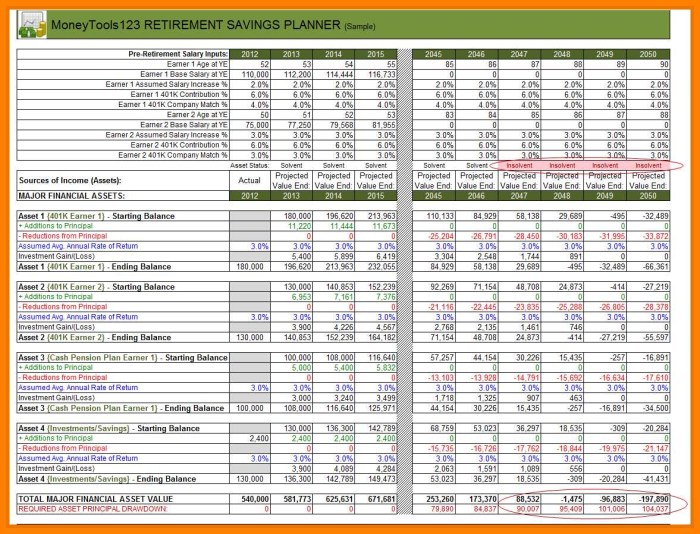
Securing a comfortable retirement requires meticulous planning, and a well-structured budget is paramount. This guide navigates the complexities of retirement financial planning, offering a practical framework to assess your needs, estimate income, manage expenses, and strategize savings effectively. Understanding these key areas empowers you to build a financially sound and fulfilling retirement.
From defining your retirement goals and estimating income sources like Social Security and pensions, to managing expenses and exploring various savings vehicles such as 401(k)s and IRAs, this comprehensive guide provides the tools and knowledge necessary for successful retirement budget planning. We’ll also address risk management strategies to protect your financial future against unforeseen circumstances.
Defining Retirement Needs and Goals
Planning for retirement involves a thorough understanding of your individual needs and the establishment of clear, achievable goals. This process requires careful consideration of various factors to ensure a comfortable and fulfilling retirement. Failing to adequately address these aspects can lead to financial insecurity and unmet expectations during this significant life stage.
Several key factors significantly influence individual retirement needs. Lifestyle preferences play a crucial role, dictating the level of spending required to maintain a desired standard of living. For instance, someone who enjoys frequent travel and fine dining will naturally require a larger retirement nest egg than someone with more modest aspirations. Health expectations are equally important; anticipated healthcare costs, including potential long-term care needs, can significantly impact retirement expenses.
The increasing costs of healthcare, especially for chronic conditions or age-related illnesses, necessitate careful planning and potentially supplemental insurance. Finally, potential long-term care costs, such as assisted living or nursing home care, can be substantial and should be factored into retirement planning. These costs can vary widely based on location, the level of care required, and the duration of care needed.
For example, the average annual cost of a nursing home in the United States can exceed $100,000, highlighting the importance of proactive planning.
Factors Influencing Retirement Needs
To determine your specific retirement needs, consider the following:
- Current Lifestyle: Analyze your current spending habits to project future needs. Consider both essential expenses (housing, food, utilities) and discretionary spending (travel, hobbies, entertainment).
- Projected Lifestyle Changes: Will your lifestyle change significantly in retirement? Will you travel more, pursue new hobbies, or reduce your work hours?
- Health Expectations: Consider potential health issues and their associated costs. Factor in insurance premiums, prescription drugs, and potential long-term care needs.
- Inflation: Account for the erosion of purchasing power due to inflation. Retirement expenses will likely increase over time.
- Unexpected Expenses: Build a buffer for unforeseen circumstances, such as home repairs or medical emergencies.
Setting Realistic Retirement Goals
Setting realistic and achievable retirement goals involves a structured process. This includes defining both financial objectives and desired lifestyle changes, ensuring alignment between your aspirations and your financial capabilities.
Begin by estimating your desired annual retirement income. This should cover your projected expenses, accounting for inflation and potential unexpected costs. Then, determine the amount of savings you’ll need to generate that income, considering factors like investment returns and withdrawal rates. Finally, develop a savings plan to bridge the gap between your current savings and your target retirement nest egg.
This plan should incorporate regular contributions and consider adjustments based on market fluctuations and life changes.
Regular Review and Adjustment of Retirement Goals
Regularly reviewing and adjusting your retirement goals is crucial. Life is unpredictable, and circumstances can change significantly over time. Economic fluctuations, unexpected health issues, or changes in family dynamics can all impact your retirement plans. Annual reviews allow you to assess your progress, make necessary adjustments, and ensure your plan remains on track. For example, a significant market downturn might necessitate increased savings contributions or a reevaluation of your withdrawal strategy.
Similarly, a major health event could necessitate adjusting your healthcare coverage and long-term care plans. Flexibility and adaptability are key to successful retirement planning.
Estimating Retirement Income
Accurately estimating your retirement income is crucial for planning a financially secure future. This involves identifying all potential income streams and projecting their future value, considering factors like inflation and potential variability. A realistic assessment allows for informed decision-making regarding savings, spending, and adjustments to your retirement plan.
Potential Retirement Income Sources
Understanding your potential income sources is the first step in creating a reliable retirement budget. These sources can vary greatly depending on individual circumstances and career history. Below is a table illustrating some common sources and their potential variability. Remember that these are estimates, and your actual income may differ.
| Income Source | Estimated Monthly Amount (USD) | Variability | Notes |
|---|---|---|---|
| Social Security | $1,500 | Low (subject to annual cost of living adjustments) | Based on average earnings history; benefits vary significantly. |
| Pension | $1,000 | Low (typically fixed, unless defined contribution) | This amount assumes a traditional defined benefit pension; many now use defined contribution plans with variable returns. |
| Investment Returns (Stocks, Bonds, etc.) | $2,000 | High (market fluctuations) | This is a highly variable figure dependent on investment strategy, market performance, and portfolio diversification. |
| Part-time Employment/Consulting | $500 | High (dependent on work availability) | This income stream is highly variable and depends on individual skills and the availability of work opportunities. |
Inflation’s Impact on Retirement Income
Inflation steadily erodes the purchasing power of money over time. A retirement income that seems sufficient today might be inadequate in 10 or 20 years. For example, if inflation averages 3% annually, a $4,000 monthly income today will only have the purchasing power of approximately $2,900 in 10 years. This highlights the importance of considering inflation when projecting future income needs.
Strategies to mitigate the effects of inflation include investing in assets that tend to outpace inflation (like stocks and real estate), regularly adjusting your retirement savings plan to account for inflation, and diversifying your investment portfolio.
Methods for Estimating Retirement Income Needs
Several methods exist for estimating retirement income needs, each with its strengths and weaknesses. The “rule of thumb” methods offer simplicity but lack precision, while more sophisticated approaches, such as Monte Carlo simulations, provide greater accuracy but require more complex calculations and data.The 80% replacement ratio method, a common rule of thumb, suggests that retirees need approximately 80% of their pre-retirement income to maintain their lifestyle.
This is a starting point and needs adjustment based on individual circumstances, such as debt levels, healthcare costs, and desired travel. More detailed methods incorporate specific expense projections, accounting for anticipated changes in housing, healthcare, and other expenses. These detailed approaches often use specialized software or financial advisors to generate more personalized and accurate estimates. For instance, one could meticulously track expenses for a year and then project those expenses forward, adjusting for anticipated inflation and changes in circumstances.
Managing Retirement Expenses
Successfully navigating retirement requires careful planning and management of your finances. A well-structured budget is crucial for ensuring a comfortable and secure retirement, allowing you to enjoy your newfound freedom without undue financial stress. Understanding your expenses and implementing strategies to control them is a key component of this process.
Retirement expenses can vary significantly depending on individual lifestyles, geographic location, and health conditions. However, certain expenses are common to most retirees. Careful categorization and planning are essential for effective budget management.
Typical Retirement Expenses
Understanding your typical retirement expenses is the first step towards creating a realistic budget. Accurately estimating these costs will help you determine how much you need to save and how to allocate your funds effectively.
- Housing: This includes mortgage payments (if applicable), rent, property taxes, homeowner’s insurance, and maintenance costs. For homeowners, unexpected repairs can significantly impact your budget.
- Healthcare: Medical expenses, including insurance premiums, co-pays, prescription drugs, and long-term care, often constitute a substantial portion of retirement spending. Healthcare costs tend to increase with age.
- Transportation: This encompasses car payments, insurance, gas, public transportation fares, and potential maintenance or repairs. Consider the cost of owning a vehicle versus using alternative transportation options.
- Food: Groceries, dining out, and other food-related expenses are a consistent and significant part of your monthly budget. Careful meal planning and grocery shopping strategies can help reduce these costs.
- Utilities: Electricity, water, gas, and internet services are essential expenses that need to be factored into your budget. Energy-efficient appliances and mindful usage can help lower utility bills.
- Leisure Activities: Travel, hobbies, entertainment, and social activities contribute to a fulfilling retirement. While these are discretionary, allocating a reasonable amount can enhance your quality of life.
- Personal Care: This includes items such as clothing, toiletries, and personal grooming services. These expenses, while seemingly small individually, add up over time.
- Taxes: Retirement income may be subject to taxes, which must be included in your budget calculations. Consult a financial advisor for personalized tax planning.
Strategies for Reducing Retirement Expenses
Several strategies can help you control and reduce your retirement expenses, allowing your savings to last longer. Adopting a more frugal lifestyle, while still enjoying a fulfilling retirement, is achievable with careful planning.
- Downsizing your home: Moving to a smaller home or apartment can significantly reduce housing costs, including property taxes and maintenance.
- Relocating to a lower cost of living area: Consider moving to a region with lower housing costs, taxes, and overall expenses. This can free up significant funds for other priorities.
- Adopting a more frugal lifestyle: This involves making conscious choices to reduce spending on non-essential items and services. Examples include cooking at home more often, utilizing free community resources, and limiting entertainment expenses.
- Negotiating lower costs for services: Contact service providers such as insurance companies, utility companies, and telecommunication companies to negotiate lower rates.
- Taking advantage of senior discounts: Many businesses offer discounts to seniors on goods and services. Taking advantage of these can add up to significant savings over time.
Sample Retirement Budget
A sample budget provides a framework for allocating funds across different expense categories. Remember to adjust this based on your individual needs and circumstances. This example assumes a monthly income of $4,000.
| Expense Category | Estimated Monthly Cost | Percentage of Budget | Strategies for Cost Reduction |
|---|---|---|---|
| Housing | $1,200 | 30% | Downsizing, relocating to a lower cost area |
| Healthcare | $800 | 20% | Exploring different insurance plans, utilizing generic medications |
| Transportation | $300 | 7.5% | Using public transportation, carpooling, reducing driving distance |
| Food | $600 | 15% | Cooking at home more often, meal planning, reducing dining out |
| Utilities | $200 | 5% | Energy-efficient appliances, mindful energy usage |
| Leisure Activities | $400 | 10% | Exploring free or low-cost activities, utilizing senior discounts |
| Personal Care | $100 | 2.5% | Buying in bulk, utilizing coupons |
| Taxes | $400 | 10% | Tax planning with a financial advisor |
Retirement Savings Strategies
Planning for a comfortable retirement necessitates a robust savings strategy. This involves understanding the various retirement savings vehicles available, diversifying your investments, and consistently contributing to maximize your returns. The earlier you begin saving, the more time your investments have to grow, leveraging the power of compounding.
Choosing the right savings vehicles and managing your investments wisely are crucial steps in securing your financial future. Understanding the features, benefits, and risks associated with each option allows you to build a personalized retirement plan aligned with your goals and risk tolerance.
Retirement Savings Vehicles
Several vehicles offer tax advantages and growth potential for retirement savings. Each has unique characteristics that should be carefully considered based on individual circumstances and financial goals.
- 401(k): A retirement savings plan sponsored by employers. Contributions are often tax-deductible, and employers may match a portion of employee contributions. Growth is tax-deferred, meaning taxes are paid upon withdrawal in retirement. Risks include potential job loss impacting access to funds and investment performance depending on the plan’s options.
- Traditional IRA: An individual retirement account that offers tax-deductible contributions. Growth is tax-deferred, with taxes paid upon withdrawal. Contribution limits apply, and income limitations may restrict eligibility for tax deductions. Risks are associated with the chosen investments within the IRA.
- Roth IRA: Similar to a Traditional IRA, but contributions are made after tax, meaning no tax deduction at contribution. However, withdrawals in retirement are tax-free. Income limitations may restrict eligibility. Risks involve the performance of the chosen investments.
Diversification of Retirement Savings
Diversification is a cornerstone of successful long-term investing. It involves spreading your investments across different asset classes to reduce risk and potentially increase returns. By not putting all your eggs in one basket, you mitigate the impact of poor performance in any single investment.
A diversified portfolio might include a mix of stocks (both large-cap and small-cap), bonds (government and corporate), and potentially real estate or other alternative investments. The specific allocation depends on individual risk tolerance and time horizon.
For example, a moderately conservative portfolio might allocate 60% to stocks and 40% to bonds, while a more aggressive portfolio might allocate 80% to stocks and 20% to bonds. The proportion of each asset class should be adjusted based on your age, risk tolerance, and financial goals. A younger investor with a longer time horizon might tolerate a higher allocation to stocks, while an older investor closer to retirement might prefer a more conservative allocation.
Impact of Savings Rates and Investment Returns
The amount saved and the rate of return significantly influence retirement savings accumulation. Even small differences in savings rates and investment returns can have a substantial impact over time due to the power of compounding.
Consider two hypothetical scenarios:
Scenario 1: An individual saves $5,000 annually with an average annual return of 7% for 30 years. Using a compound interest calculator, this would result in approximately $380,000 at retirement.
Scenario 2: An individual saves $10,000 annually with an average annual return of 7% for 30 years. This would result in approximately $760,000 at retirement.
This illustrates the significant impact of increasing savings contributions. Similarly, even a small increase in the average annual return can substantially increase the final amount. A 1% increase in annual return in Scenario 2, for example, could yield an additional $100,000 or more at retirement.
Consistent savings and strategic investing are key to achieving your retirement goals. The earlier you start, the better.
Careful retirement budget planning isn’t merely about accumulating savings; it’s about crafting a sustainable financial roadmap for a secure and enjoyable retirement. By thoughtfully considering your needs, income sources, expenses, and risk mitigation strategies, you can create a plan that aligns with your aspirations and provides peace of mind for the years ahead. Remember that regular review and adjustment are crucial to adapt to life’s changes and maintain a financially healthy retirement.
FAQ Insights
How often should I review my retirement budget?
At least annually, or more frequently if significant life changes occur (e.g., job loss, health issues).
What if my retirement income projections are lower than expected?
Re-evaluate your expenses, consider delaying retirement, explore part-time work options, or adjust your lifestyle expectations.
What is the role of inflation in retirement planning?
Inflation erodes purchasing power. Factor in an inflation rate when projecting future expenses and consider inflation-protected investments.
Can I use a financial advisor to help with retirement planning?
Yes, a financial advisor can provide personalized guidance and assistance with various aspects of retirement planning.


